Reimagining Just Education
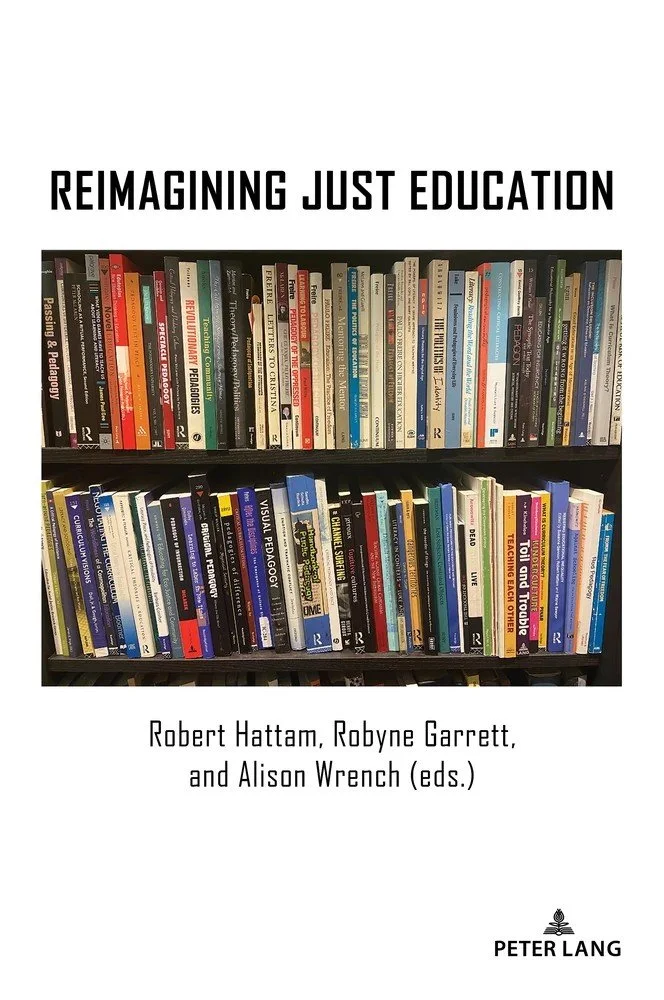
Our Chapter about the Wicked Problem of Alternative schooling has been published in Reimagining Just Education.
Book Summary In this edited book we argue that we are now involved in a struggle over the soul of educators and that means resisting the neoliberalizing policy regime that mostly governs through asserting a narrow, technicist, and individualistic definition of what it means to be a good teacher. The book represents the recent scholarship of the Pedagogies for Justice Research Group at the University of South Australia. The research reported is framed up by a critical sensibility that we understand in these terms: a skepticism toward common-sense and official knowledge; a sensitivity toward how power works on and through knowing and subjectivity; and a commitment to more socially just societies. The book focuses on three key ideas: (1) responding to the educational disengagement; (2) providing hopeful alternative accounts of socially critical pedagogies in a range of different sites; and (3) rethinking curriculum and pedagogy across the curriculum.
Scaled Up “Safety-Net” Schooling and the “Wicked Problem” of Educational Exclusion in South Australia—Problem or Solution?
Andrew Bills, David Armstrong, and Nigel Howard
Chapter Introduction In this chapter we investigate a major, long-running policy intervention to combat educational exclusion in South Australia: the Innovative Community Action Networks (ICAN)-Flexible Learning Options (FLO) policy and program agenda. ICAN was discontinued but FLO was its legacy as the only bureaucratically systematized “alternative” schooling approach to addressing the problem of early school leaving in Australia. We frame FLO using the concept of wicked problems in policy and specify how some problematic features of FLO since its inception in 2007 are predicted by this concept. Problems with FLO include: a lack of public accountability; shortcomings in the transparency of the attainment of enrolled students; and the consequent danger that public confidence in FLO could be undermined. This was borne out when a wide-ranging inquiry into suspension, exclusion, and expulsion (Graham et al., 2020) recommended the program be discontinued. The Department for Education (DfE) chose a “redesign” instead that offered little change other than a change of name to Tailored Learning Provision (TLP) and an imposition of some more guidance on schools. We offer constructive suggestions to address these weaknesses, including more conceptual policy work in partnership with collective stakeholder inquiry and research. We conclude that one ever-present danger with social inclusion initiatives like FLO and its younger redesigned cousin TLP is that they become a parallel education system for the disadvantaged and thereby corrode the principle of an inclusive mainstream education system meeting the needs of all children and young people.
The South Australian FLO program has catered for over 60,000 annual enrolments of students over a fifteen-year period at a total public enrolment cost of hundreds of millions of dollars. ICAN-FLO began as a localized policy response to the larger “wicked problem” of educational exclusion. Our analysis in what follows draws attention to problematic features of the FLO program and conceptualizes these features in terms of recent accounts which highlight flawed or inadequate policy responses to educational exclusion in Australia (Graham et al., 2015).